Top Landmarks in Los Angeles
Los Angeles, CA is one of the most geographically sprawling cities in the United States, home to nearly 3.9 million residents and a constellation of landmarks recognized far beyond California's borders. The scale of the city can feel disorienting on a first visit — but once you understand how its neighborhoods cluster, the major landmarks become easier to plan around. Most visitors find it practical to group stops by area rather than attempting to cross the entire city in a single day.
For a fuller picture of what the city offers beyond landmarks, see the Los Angeles Travel Guide: Things to Do, Landmarks, Food, and Itineraries.
Hollywood and the Hills
No cluster of landmarks in Los Angeles, CA is more widely photographed than the one anchored by the Hollywood Sign. Perched on Mount Lee at the southern edge of the Santa Monica Mountains, the sign has stood in some form since 1923, originally spelling out "HOLLYWOODLAND" as an advertisement for a hillside real estate development. Today its 45-foot-tall white letters are maintained by the City of Los Angeles. Visitors cannot walk up to the sign itself, but several trails within Griffith Park — including routes from the Bronson Canyon area and along the Mulholland Trail — bring you to vantage points with a clear, unobstructed view. Trail access conditions and any permit requirements can change seasonally; check the City of Los Angeles and Griffith Park sites before heading out.
Just below those hills sits Griffith Observatory, one of the most recognizable structures in Los Angeles, CA. Opened in 1935, this Art Deco building on the south slope of Mount Hollywood offers a wide view of the Los Angeles Basin, the Hollywood Sign, and on clear days, the Pacific coast. Inside, the observatory houses a planetarium theater, astronomy exhibits, and public telescopes available during evening programs. Current hours and admission details are posted on the observatory's official website — worth checking in advance, especially on weekends when lines can be long.
Along Hollywood Boulevard, the Hollywood Walk of Fame stretches for more than a mile and includes over 2,700 terrazzo-and-brass stars set into the sidewalk, honoring figures from film, television, music, and radio. Nearby, TCL Chinese Theatre — historically known as Grauman's Chinese Theatre — draws consistent crowds to its famous forecourt, where celebrity hand- and footprints have been pressed into cement since 1927. Both are free to walk past and are a natural pairing with the Walk of Fame.

Downtown Los Angeles
Downtown Los Angeles, CA contains one of the city's densest concentrations of historic and cultural landmarks, making it practical to cover several in the same half-day on foot.
Union Station, completed in 1939, blends Mission Revival, Spanish Colonial Revival, and Streamline Moderne architecture into a building that still functions as the region's primary rail hub, served by Metro Rail lines and Amtrak. It is both a working transit station and an architectural landmark worth exploring in its own right.
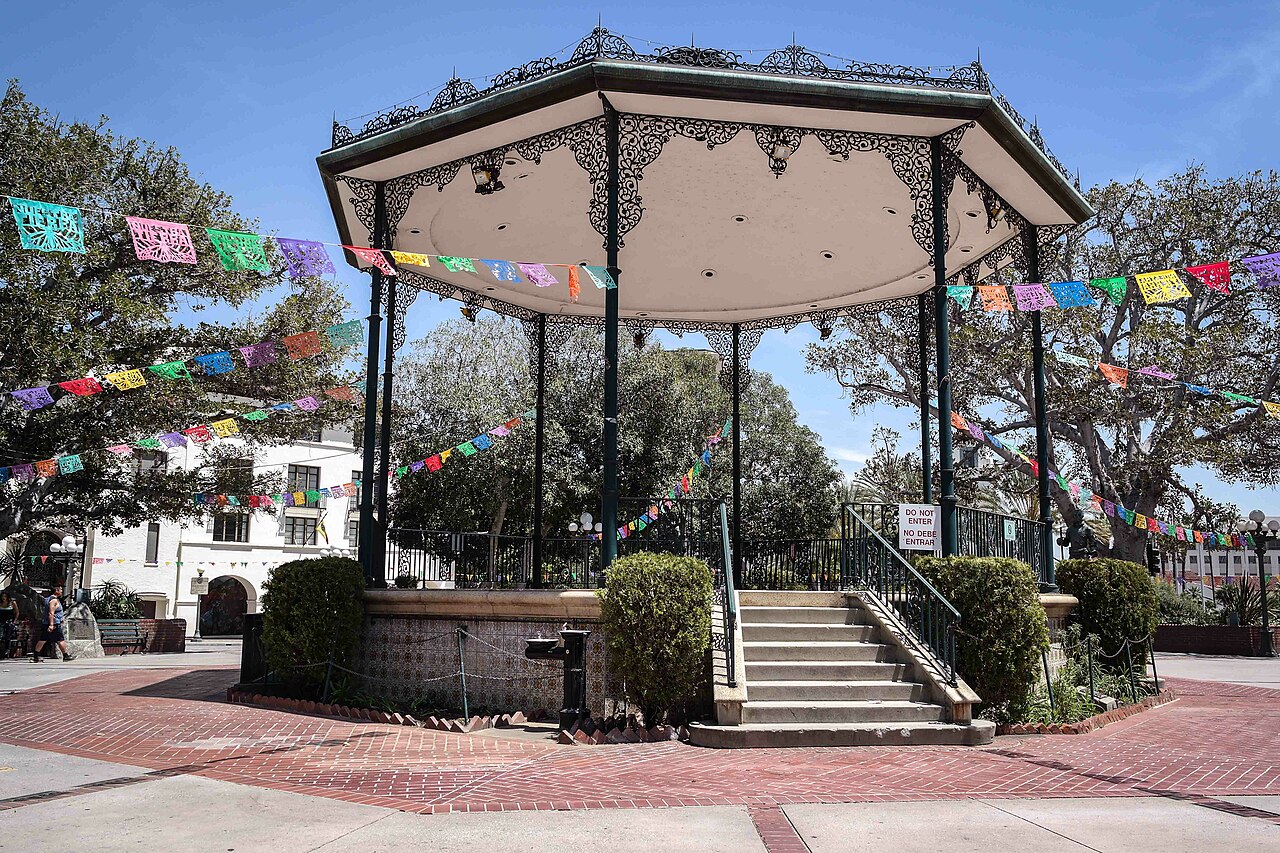
A short walk from the station, Olvera Street and the surrounding El Pueblo de Los Ángeles Historical Monument mark the general area of the city's founding in 1781. The oldest surviving structures in Los Angeles, CA are located here, including the Avila Adobe — commonly identified as the city's oldest remaining residence.
On South Broadway, the Bradbury Building is one of the most studied 19th-century commercial structures in California. Its interior atrium — a skylit court with ornate cast-iron galleries and open-cage elevators — has appeared in numerous films and remains a striking example of Victorian commercial architecture. The building is privately owned with limited public access; check current visiting information before making it a destination.
In the Bunker Hill neighborhood, The Broad on Grand Avenue and the Museum of Contemporary Art (MOCA) are both within walking distance of each other, making them an efficient pair for anyone interested in contemporary and modern art. Admission policies and reservation windows vary by season; consult each museum's official site.
Grand Central Market on South Broadway has operated continuously since 1917 and functions today as a large indoor market with a wide range of food vendors — a practical and popular midday stop when exploring Downtown.
Museum Row and Exposition Park
The stretch of Wilshire Boulevard between Fairfax and Curson Avenues, sometimes referred to as Museum Row, anchors a cluster of major institutions.
The Los Angeles County Museum of Art (LACMA) is the largest art museum in the western United States by collection size, with holdings spanning ancient artifacts through contemporary works. The La Brea Tar Pits, adjacent to the LACMA campus, are a genuine rarity: an active paleontological excavation site in the middle of a major city, where fossils continue to be pulled from naturally occurring asphalt pools. The Page Museum on the same grounds houses many of the recovered Ice Age specimens.
A short drive south, Exposition Park holds two more significant institutions: the Natural History Museum of Los Angeles County, with extensive fossil, mineral, and cultural collections, and the California Science Center, which is home to Space Shuttle Endeavour — one of only four orbiters preserved for public display in the country. Admission and reservation requirements differ between these two museums; check each one's site directly.
The Westside
The Getty Center in Brentwood is a sprawling hilltop campus designed by architect Richard Meier and opened in 1997. The permanent collection includes European paintings, sculpture, decorative arts, manuscripts, and photography. The grounds and gardens draw visitors on their own merits. Parking reservations are typically required for those arriving by car — the Getty's official site has current details. Metro bus service also reaches the area.
Along the coast, Santa Monica Pier is among the most photographed spots in Los Angeles, CA. Extending over the Pacific since 1909, the pier includes a small amusement park, an aquarium, and a sign marking the western terminus of Route 66 — a modest but meaningful endpoint for fans of the historic highway.
South of the pier, Venice Beach offers a different character: the wide boardwalk, the early-20th-century canals (a remnant of the original development plan for the area), and the outdoor muscle beach gym are all accessible on foot and at no charge.
How the Landmarks Cluster Geographically
The geography of Los Angeles, CA rewards deliberate planning. The major landmarks fall into four rough clusters:
- Hollywood and Griffith Park — Griffith Observatory, Hollywood Sign viewpoints, and the Hollywood Walk of Fame are all within a few miles of each other.
- Downtown — Union Station, El Pueblo de Los Ángeles, the Bradbury Building, Grand Central Market, and the Bunker Hill museums form a walkable circuit.
- Mid-Wilshire and Exposition Park — LACMA, the La Brea Tar Pits, the Natural History Museum, and the California Science Center are grouped close enough to combine.
- The Westside — The Getty Center is inland while Santa Monica Pier and Venice Beach are on the coast; plan for a drive between them.
None of these clusters are walkable from one another — Los Angeles, CA is built around the car. Metro Rail lines connect Downtown to Hollywood and to portions of the Westside. Buses extend coverage further. Where available, contactless tap-to-pay is the standard boarding method for Metro; current fares, route maps, and pass options are on the LA Metro website.
Practical Planning Notes
Street parking regulations across Los Angeles, CA are strictly enforced and vary by neighborhood; posted signs should always be read carefully. For attraction-specific parking, fees and reservation requirements are best confirmed on each venue's official site — policies change and vary significantly.
Weather in Los Angeles, CA is mild by most standards, but marine layer fog along the coast can affect visibility at outdoor landmarks like the Santa Monica Pier. For guidance on which months tend to work best for outdoor exploration, the Best Time to Visit Los Angeles page covers seasonal patterns.
If time is limited, the Los Angeles 1-Day Itinerary focuses on a practical combination of landmarks accessible without excessive backtracking. For a more comprehensive tour, the Los Angeles 3-Day Itinerary maps out routes across most of the clusters described here.
Food Near the Landmarks
Los Angeles, CA has several thousand restaurants and cafes mapped across the metro area, with strong concentrations near all of the landmark clusters covered here. Grand Central Market in Downtown and the Original Farmers Market at 3rd and Fairfax — which has operated since 1934 — are two well-known options for casual eating near major attractions. For a broader overview of the dining landscape across the city, Where to Eat in Los Angeles covers neighborhoods and cuisines in more depth.
Approaching Los Angeles Systematically
Los Angeles, CA rewards visitors who plan around geography. The landmarks here span more than a century of architecture, science, art, and cultural history — and each neighborhood they anchor has its own distinct character. Because distances are real and traffic is an everyday factor, advance planning consistently pays off. Check official websites for current hours, reservation requirements, and admission policies before any visit, since these details change more frequently than most printed guides can keep pace with.
For answers to common planning questions — transportation options, neighborhood basics, and what to realistically expect — the Los Angeles FAQ is a useful starting point. For activities and experiences beyond the landmark circuit, Best Things To Do in Los Angeles covers the full range of options across the city.