Top Landmarks in Woburn

Woburn, Massachusetts sits a short drive north of Boston, and its landmarks reflect a city that grew up around a New England town common, an early industrial economy, and one of the region's more unusual scientific legacies. For a broader overview of the city, the Woburn Travel Guide: Things to Do, Landmarks, Food, and Itineraries is a good starting point before diving into specific sites. This page focuses on the landmarks most commonly pointed to when people talk about what makes Woburn worth a look, how they're grouped geographically, and how a visitor might string them together on foot.
Woburn Common and Its Historic Cluster
The center of the city's landmark district is Woburn Common, a compact green that has anchored civic and religious life in Woburn for generations. Several of the city's most recognizable buildings sit within easy walking distance of the common, which makes it a natural first stop for anyone exploring on foot.
The standout building here is the Winn Memorial Library (Woburn Public Library), designed by architect Henry Hobson Richardson in the Romanesque Revival style he became known for nationally. Its rough-cut stone exterior, deep archways, and tower are commonly cited as one of the more architecturally significant public buildings in the region, and the structure is often mentioned alongside Richardson's other well-known commissions in Massachusetts. Even for visitors who aren't especially interested in library architecture, the building's silhouette is distinctive enough to be worth a slow walk around the exterior.
Just steps away, the First Congregational Church of Woburn contributes a tall steeple to the skyline around the common and reflects the congregational tradition common to many older Massachusetts town centers. Between the church, the library, and Woburn's municipal buildings, this small area concentrates a good share of the city's most photographed architecture into a walkable footprint, and it pairs naturally with a stop for a meal — see Where to Eat in Woburn for options near the center of the city.
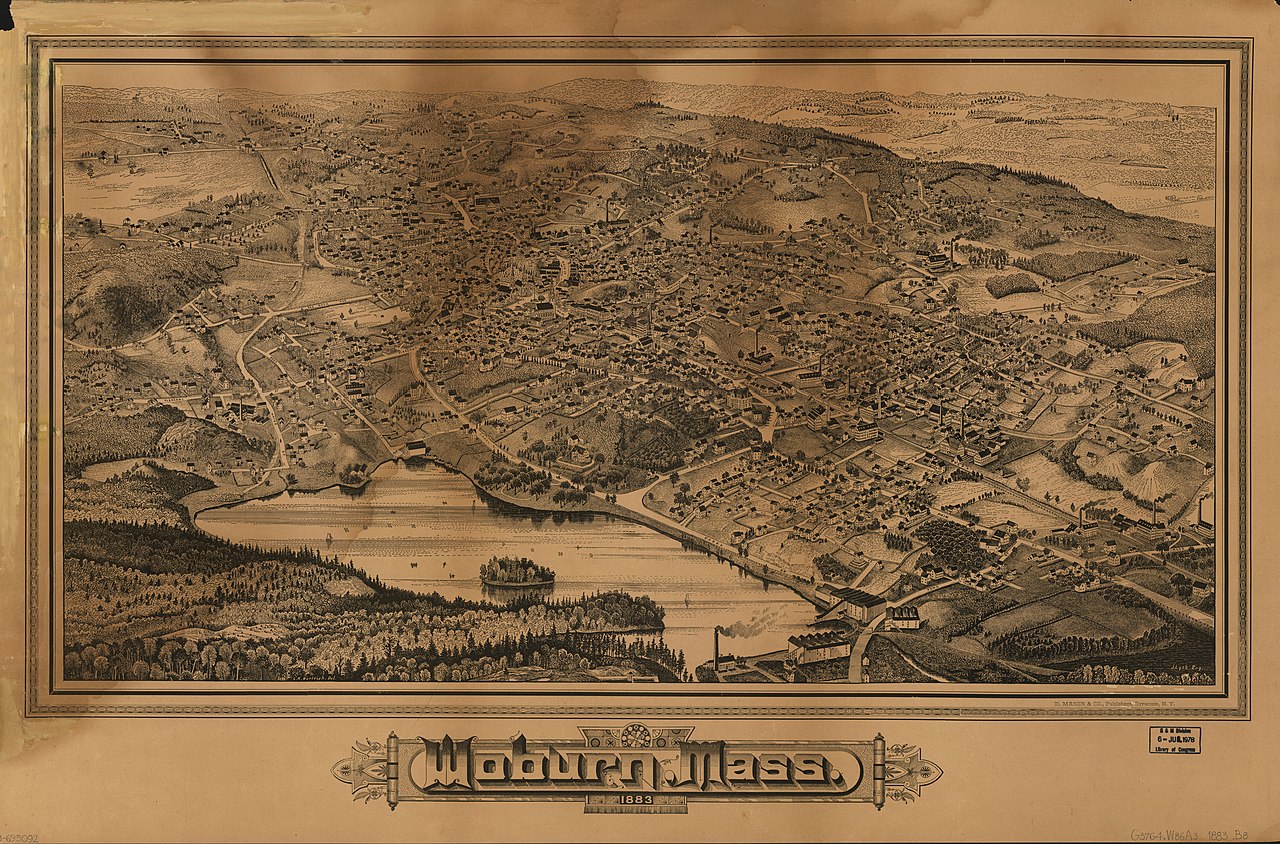
Horn Pond
A short distance from the downtown core, Horn Pond is one of the more commonly visited natural landmarks in Woburn. The pond and its surrounding parkland have long served as a recreational gathering spot for residents, with a path that circles the water and connects to adjoining conservation land, including the rise known locally as Horn Pond Mountain. It's a popular destination for walking, birdwatching, and generally spending time outdoors without leaving the city limits. Because the terrain and trail conditions can shift with the seasons, it's worth checking current conditions before planning a longer loop, and the Best Time to Visit Woburn page can help with thinking through seasonal timing for an outdoor-focused visit.
The Count Rumford Birthplace
North Woburn is home to the birthplace of Benjamin Thompson, better known by his later title, Count Rumford — a Woburn-born scientist and inventor whose work on heat and thermodynamics gained international recognition in the eighteenth century. The house associated with his birth is a well-known point of local historical interest and is commonly referenced in discussions of Woburn's early history. It sits apart from the downtown cluster, so visitors typically treat it as a separate stop rather than folding it into a common-area walk, but it rewards anyone with an interest in early American science or the city's colonial-era roots.
Traces of the Middlesex Canal
Woburn is also connected to the history of the Middlesex Canal, the early nineteenth-century waterway that once linked the Merrimack River to Boston Harbor and is often cited as one of the first major canal projects in the United States. Remnants of the canal's path and structures can still be found in and around Woburn, and the city's ties to canal engineer Loammi Baldwin — also linked to the origin of the Baldwin apple — add another layer to the area's industrial history. These traces are more scattered than the Common or Horn Pond, so they tend to suit visitors who enjoy tracking down historical markers rather than a single defined stop.
Combining the Landmarks Into a Walk
Because Woburn's landmarks aren't clustered into one dense district, a practical approach is to treat the Woburn Common area as the anchor for a walking segment — covering the library, the church, and nearby civic architecture — and then plan separate stops for Horn Pond and the Count Rumford Birthplace, either by a short drive or a longer walk depending on time and comfort with the distance. As with any city, it's worth keeping ordinary urban awareness in mind when moving between neighborhoods, especially around dusk.
For a structured way to fit these landmarks into a visit, the Woburn 1-Day Itinerary lays out a single-day route, while the Woburn 3-Day Itinerary allows more time to separate the downtown cluster from the outlying sites. Anyone weighing whether these landmarks are worth building a trip around might also start with the Best Things To Do in Woburn page for a fuller picture of the city's attractions, or check the Woburn FAQ for answers to other common planning questions.
Woburn's population of roughly 41,000 and its position just outside Boston mean the city functions as both a residential community and an easy day-trip destination, and its landmarks — a Richardson library, a historic pond, a scientist's birthplace, and canal-era remnants — reflect a fairly wide span of the region's history in a relatively compact area.